There’s a particular kind of evening I know well. The kettle’s boiled, the blanket’s on, and my thumb is already scrolling through something I won’t remember tomorrow. Lately I’ve been swapping that scroll for a small hoop, a ball of wool and a hollow needle that turns plain fabric into something soft and loopy.
Punch needle is quiet, rhythmic and forgiving, which makes it a perfect fit for anyone who loves slow hobbies. Here’s why it works as self-care, what you need, how to make your first piece and how to turn it into a ritual you’ll look forward to.
Why punch needle works as creative self-care
Most of us don’t need another hobby that demands performance. We need one that gives us something to do with our hands while our heads settle. Punch needle does that beautifully: you push, lift and glide, and a row of plush loops appears behind the needle. Progress is visible within minutes, and there’s no wrong move you can’t gently pull out and redo.
If you’d rather skip the guesswork of matching fabric, yarn and a pattern, a set of Punchora punch needle kits puts everything in one box, so your first evening is spent punching rather than shopping. That matters more than it sounds. Choosing supplies is where plenty of beginners lose their nerve.
The wellbeing side isn’t just a feeling, either. A 2025 report from Hobbycraft and Mind found that around 8.8 million Brits use arts and crafts to look after their mental health. Of those surveyed, 59% felt a sense of achievement, 53% said their mood improved and 48% said their stress reduced. The research was commissioned by a craft retailer, so treat the figures as encouraging rather than conclusive.
If you’ve already tried a low-pressure creative ritual like paint by numbers, you’ll recognise the feeling. Punch needle adds texture, which I find oddly soothing.

The list is short. You need:
- A hoop or gripper frame. The fabric must be drum-tight. Loose fabric is the number one reason loops pull out.
- Monk’s cloth. Its open weave lets the needle pass through easily.
- A punch needle and threader. The needle is hollow, and the threader gets yarn through the eye without swearing.
- Medium-weight wool yarn. Wool grips the fabric better than slippery acrylic, which is why beginners usually have an easier time with it.
Tension is the whole game. Pull the cloth tight, keep the yarn flowing freely from the ball, and the stitches will sit evenly. If it feels like a fight, something is too tight or too loose.
Your first project in six steps
Keep it small. A simple shape such as a heart, a mushroom or a moon is plenty.
- Stretch the fabric across the hoop and tighten until it sounds like a tiny drum.
- Draw your design in pencil or marker. Remember you’re working from the back, so any lettering needs to be drawn in reverse.
- Thread the needle and leave a short tail of yarn.
- Punch down to the hilt, then lift only until the tip just clears the cloth. Lifting too high is the classic way to lose a loop.
- Outline first, then fill in with spirals, working from the edge towards the middle.
- Finish off by snipping the yarn at the back and tucking in the end, then a dab of fabric glue if you like.
Your first piece will be a bit wonky, and honestly, that’s its charm. Mine looked like a startled marshmallow. I loved it anyway.
Making it a ritual, not a chore
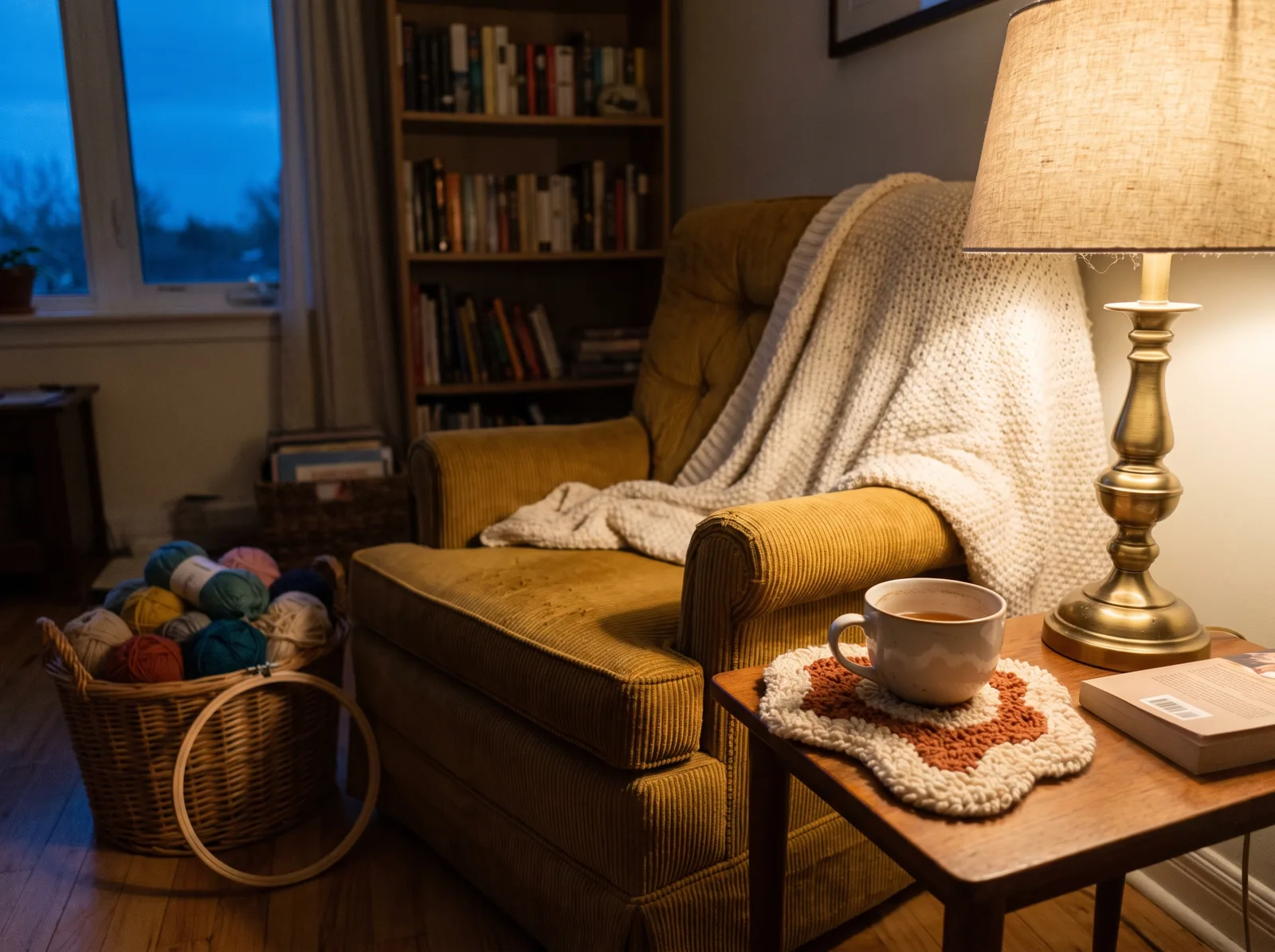
The hobby sticks when it’s tied to a little ceremony. Set up a corner with a lamp, a blanket and a hot drink, and keep your hoop somewhere you can reach it without tidying first. Twenty minutes is plenty. Put on a playlist or a podcast, or the soundtrack of your favourite cosy game, and let your hands do the work.
It sits happily alongside other creative hobbies for women too. I like to alternate: punch needle on Tuesdays, a junk journal page on Sundays. Variety keeps any one craft from becoming another obligation.
What the research says about crafting and wellbeing
The evidence is steadily building. A 2024 analysis in Frontiers in Public Health examined data from 7,182 adults in England and found that creating arts and crafting positively predicts subjective wellbeing. The authors note that roughly 20% of the British population take part in arts and crafts.
More recently, a 2026 literature review in Taylor & Francis textile research reported that wellbeing benefits appeared across textile crafts, regardless of the specific craft or the people taking part. That’s good news if you worry you’re doing it “wrong”. The calm seems to come from the making itself.
A fair caveat: much of this research shows association, not proof that a hoop and some wool will fix a hard week. Think of punch needle as one small, kind habit rather than a cure.
Ideas for what to make next
Once you’ve got the knack, small projects are the most satisfying. Try:
- Coasters, which are quick and genuinely useful
- Bookmarks in your favourite colours
- A tiny wall hanging for your reading nook
- Gifts, such as a personalised patch for a friend’s tote bag
A finished piece also tucks nicely into a self-care basket if you’re putting one together for someone who needs a bit of looking after.
Final thoughts
You don’t need a studio, a plan or any talent to begin. One hoop, one evening and a ball of wool is enough. Start small, keep the loops loose and let the rhythm of it do its quiet work.